Tuesday, November 11, 2014

Thankful for Each Veteran!


Today, as in previous years, the annual Veterans Day Observance I attended included a reading* entitled, “What Is a Veteran?” According to its author, Anthony Barton Hinkle, the answers are as varied as the veterans themselves. A veteran may be the “old guy bagging groceries at the supermarket,” or “the parade-riding legionnaire who pins on his ribbons and medals with a prosthetic hand.” As Hinkle points out, “Some veterans bear visible signs of their service: a missing limb, a jagged scar, a look in the eye. Others may carry the evidence inside them: a pin holding a bone together, a piece of shrapnel in the leg – or perhaps another sort of inner steel: the soul’s alloy forged in the refinery of adversity. Except in parades, however, the men and women who have kept America safe wear no badge or emblem. You can’t tell a vet just by looking.”


As Hinkle so rightly concludes, a veteran “is an ordinary and yet an extraordinary human being – a person who offered some of his [or her] life’s most vital years in the service of his country, and who sacrificed his ambitions so others would not have to sacrifice theirs.”

I’m very thankful for the service each veteran has given, and I’m glad that each November 11th people all over this great country assemble to pay tribute to them and to thank them for helping ensure the freedoms we enjoy.

*An editorial that first appeared in 1995 in the Richmond Times-Dispatch.


Tuesday, October 28, 2014

Linger Long


I noticed something quite peculiar while visiting Yellowstone National Park. Huge crowds gathered to wait for Old Faithful’s next eruption. Some who arrived shortly after the geyser’s last eruption would wait over an hour to watch the next one. They’d wait despite the weather. For example, one day the sunshine gave way to a sudden storm that produced thunder, lightning, and about an inch of ice pellets all over the ground. Even so, the visitors to Old Faithful stayed nearby. Some sought shelter inside the nearby buildings; others remained on the boardwalk.

But that was not the peculiar thing I observed. Neither was it the hush that descended upon the crowd as the time for the eruption neared. Neither was it the collective gasp of hundreds of onlookers as sprays of water and steam began spewing hundreds of feet into the air.
The peculiar thing I observed was the leaving of the crowd mere moments after the eruption began. As soon as most visitors had taken a photo or two, they rushed away to see another of the many wonders of Yellowstone.

I thought it odd that they chose not to linger even a few minutes to enjoy the awesome sight, which lasts less than five minutes. Five minutes!

Apparently, it isn’t easy to hold attention these days—no matter how riveting the performance. Sadly, far too many of us rush on to the next big event, eager to add one more thing to our been-there-done-that list.

We seem to have lost the ability to reflect on the wonder that is before us, whether that wonder is an erupting geyser or a flower flourishing in the cracks in the sidewalk.
How much better it would be if only we were like the people I observed sitting beside scenic sites they’d hiked more than a mile to see. Instead, after we’ve huffed and puffed to reach natural wonders like cascading waterfalls or crystal-clear lakes nestled at the bottom of snow-capped mountains, we pause only long enough to take a picture or two before hurrying back to the car to see what else is ahead.

We know little about quiet reflection and deep contemplation, both of which greatly relieve stress. But by our refusal to be still and enjoy the wonders of nature, we miss out on an even greater benefit: being prompted to worship the Creator.

For example, I doubt David could have written these beautiful words if he hadn’t spent time contemplating the beauty of nature and connecting what his physical senses were experiencing to what his spiritual senses were revealing to him:
Your unfailing love, O LORD, is as vast as the heavens; your faithfulness
reaches beyond the clouds. Your righteousness is like mighty mountains, your
justice like the ocean depths. You care for people and animals alike, O LORD.
How precious is your unfailing love, O God! All humanity finds shelter in the
shadow of your wings. You feed them from the abundance of your own house,
letting them drink from your rivers of delight. For you are the fountain of
life, the light by which we see (Psalm 36:5-9, New Living Translation).

Oh, Dear Reader, may you and I learn to linger long in the presence of the Creator and His creation.

© 2006 by Johnnie Ann Burgess Gaskill. For permission to use, please contact her.

Saturday, October 25, 2014

Happiness

Happiness is like a butterfly
which, when pursued,
is always beyond our grasp, 
but, if you will sit down quietly, 
may alight upon you.
~Nathaniel Hawthorne

Friday, October 24, 2014

Interruptions

He entered Jericho and was passing through. And there was a man by the name of Zaccheus; he was a chief tax collector and he was rich. Zaccheus was trying to see who Jesus was, and was unable because of the crowd, for he was small in stature. So he ran on ahead and climbed up into a sycamore tree in order to see Him, for He was about to pass through that way. When Jesus came to the place, He looked up and said to him, “Zaccheus, hurry and come down, for today I must stay at your house."
Luke 19:1-5, NASB


During a phone conversation, a dear friend and I talked about the day we’d met (over twenty years ago).

“I just came into your office and interrupted your work,” she said.

As we laughed about that, I said, “Neither of us knew that meeting would be the beginning of a beautiful and lasting friendship, did we?”

Indeed, we have become as close as sisters as we’ve shared good times together, as well as times of struggle and heartbreak. Every conversation I have with her is a feast for our spirits as we laugh together and encourage one another.


I thought about that a day or two later as I read these words in Mark Buchanan’s wonderful book, The Rest of God: Restoring Your Soul by Restoring Sabbath: “Think a moment of all the events and encounters that have shaped you most deeply and lastingly. How many did you see coming? How many did you engineer, manufacture, chase down? And how many were interruptions?” (Location #1462, Kindle)


Yes, often what we view as an interruption is actually God’s way of blessing us far more than we could envision, His way of leading us down paths He has chosen for us. For example, consider the life of Jesus. He lived with full awareness of His purpose; yet, He used “interruptions” as opportunities for healing and teaching and meeting all sorts of needs. The “interruptions” were, in fact, an integral part of His work. That’s true for us, as well. May we realize that.

Wednesday, October 22, 2014

Refresh

So, Jesus, perceiving that they [the crowds] were intending to come 
and take Him by force to make Him King, 
withdrew again to the mountain by Himself alone.
John 4:15, NASB

Several passages of Scripture (like the one above) tell about how even Jesus needed to pull away from the pressures of life. Even He needed to pray and to seek the Father’s will in all things. Even He, for a brief time, had to leave His work, important though it was, in order to return to it even better equipped to carry it out.

Likewise, as the time drew near for His painful death on the cross, He went into the Mount of Olives, as was His custom, for a time of earnest prayer. Although His disciples went there with Him, He “withdrew about a stone’s throw beyond them, knelt down and prayed, ‘Father, if you are willing, take this cup from me; yet not my will, but yours be done’” (Luke 22:41-42, NIV).

Dear Reader, may you and I set aside time to take a brief respite from the pressures of life in order to pray, to read the Word, and to rest our souls and bodies so that we can return—refreshed and ready—to whatever work/ministry God has given us.


Note: We don’t have to go to the beach or to the mountains, etc. Any quiet, peaceful place will do!

Thursday, September 25, 2014

Wabi-Sabi

At the conclusion of a Toastmasters meeting, the leader said, “The theme for our next meeting will be wabi-sabi.”

Well…that theme was quite different from recent ones, such as enthusiasm, being prepared, rise and shine, etc., all of which were easily understood. But wabi-sabi????

Naturally, I made a bee-line for her after the meeting and smiled as I asked, “Just what is wabi-sabi?”

“It’s a Japanese word that means a way of seeing beauty in things that are imperfect, like a cracked vase. People who understand wabi-sabi intentionally place the vase so that the imperfection can be seen rather than hidden.”

After the meeting, I logged on to the internet to find out more about wabi-sabi. I learned that ancients Greeks once prized beauty; westerners desire perfection; but those who practice wabi-sabi value authenticity. They see beauty in things that are imperfect, impermanent, and/or incomplete. For example, they find beauty in things that are rough, irregular, natural, rustic…things with “character,” such as a table with a few dings and dongs, a chipped cup, wrinkled faces, etc. 

      My goodness! I thought. I’ve been practicing wabi-sabi for years and didn’t even know it! To prove it, I looked through my collection of digital photos and found many images I’d made of what I considered beautiful “finds.” I’d found them in unexpected places. For example: an outhouse made of rough wood standing beside acres of sunflowers in full bloom, outgrown children’s shoes being used as small planters, an old worn-out shoe providing a home to a plant in need of care, textured walls in an abandoned building, dried blooms silhouetted again a November sky…


 One of my all-time favorite wabi-sabi photos is one of my mother’s hands, taken when she was 86 years old. I liked it so much I even wrote a poem about her hands and placed those words onto the photo itself.


The more we accept the imperfect elements in our environment and consider them interesting and beautiful, the more willing we’ll be to let go of our relentless quest for perfection—not only in things but also in people—including ourselves!

Sunday, August 31, 2014

Undiscovered


To myself I am only a child playing on the beach, 
while vast oceans of truth lie undiscovered before me.
    ~Isaac Newton


Wednesday, August 27, 2014

Make Life Beautiful

In an article in the June 2013 issue of Southern Living magazine, writer Allison Glock talks about her great-grandfathers’ gardens, which were as different as the men themselves. One man’s garden was formal. The other’s was wild and free. Yet, each one was filled with beauty.

“In both houses,” Allison says, “there were jars of fresh flowers, blooms that reminded them that life could be beautiful, that they could make it so” (p. 78, “Portrait in Green”).

As I reflected on her words, I recalled the times I’ve visited (and photographed!) the garden of a humble, gentle-spirited man who lives in a small house. Like Allison’s great-grandfathers, this man has also surrounded himself with beauty.

He has planted flowers almost everywhere in his small yard. Other than a grassy pathway, which runs alongside his house and leads to his “sitting area” and to his small vegetable garden near the back fence, almost every available inch of his yard is ablaze with color.


In order to add a splash of color to the part of the yard that is more utilitarian than beautiful, he has hung a sunflower flag on a tree near a table covered with an assortment of unfilled flower pots.


He is happy to share the beauty of his garden with others. For example, when children in his neighborhood ask to be allowed to help him plant and weed and water, he teaches them to care for the plants and to appreciate their beauty, as he does.

Like Allison’s great-grandfathers, he believes life can be beautiful and that people can make it so.

They’re right, aren’t they? We can—and do—cultivate beauty in all kinds of spaces, whether in huge formal gardens surrounding a mansion or in limited space alongside a small house.

We also create beauty in all kinds of ways, not just in flower gardens. Consider: the chef who makes each entrée a work of art…the fashion designer who adds detail to a garment to make it uniquely beautiful…an interior designer who knows just what to put where in order to create a stunningly beautiful room.

Even folks who don’t get paid to create beauty do it instinctively. Take, for example, the person who creates beauty by artfully arranging assorted, chopped, colorful veggies…the man who washes and waxes his car until it looks brand new...the child who gathers a handful of wild flowers to present to her mother... the toddler who draws on a wall with a crayon…


Because we humans have an innate longing for beauty, we either find it—or create it!

Poets and writers use words to paint pictures for us to enjoy; photographers and artists create visual feasts. Even folks who don’t consider themselves artistic or creative, crave beauty and, thus, create it in all kinds of places and with whatever materials are at hand.

Even when life is hard—especially when life is hard—we have a need for beauty. We flank caskets with flowers to soften the harshness of death. We place flowers and balloon bouquets around the room of those who are ill. We dress in bright colors in order to lift our spirits.

Yes, life can be beautiful. And we should make it so! In the process, let’s also take time to thank our Father for the beauty He’s already provided for us, as Folliott S. Pierpoint did when, in 1864, he penned these words:
For the beauty of the earth,
For the glory of the skies,
For the love which from our birth,
Over and around us lies;
Christ our God to Thee we raise
This our hymn of grateful praise.


Tuesday, August 5, 2014

After a Rain


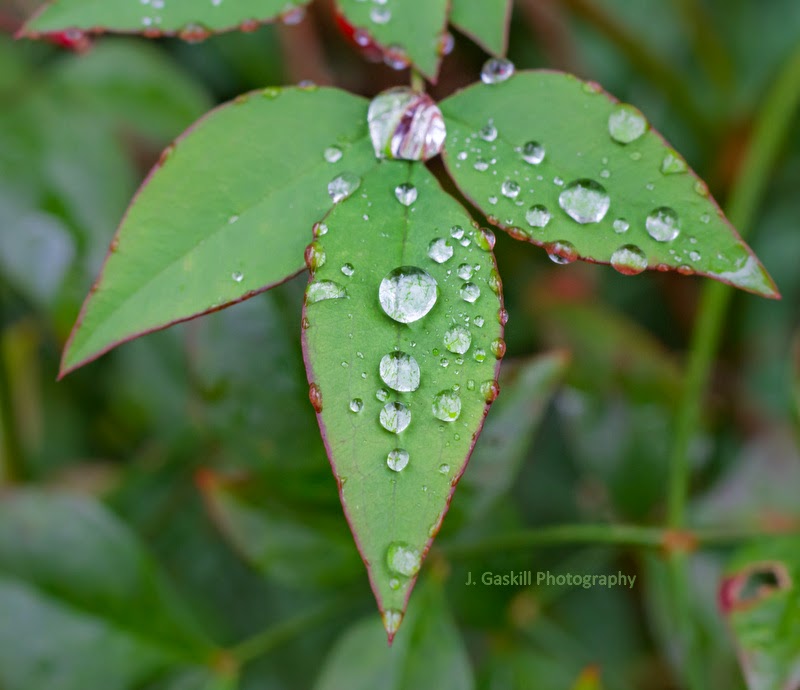
Have you ever seen clearer shining than that which follows a shower? Then the sun transforms the rain-drops into gems, the flowers look up with fresher smiles and faces glittering from their refreshing bath, and the birds from among the dripping branches sing with notes more rapturous, because they have paused awhile. So, when the soul has been saturated with the rain of penitence, the clear shining of forgiving love makes the flowers of gladness blossom all around.

~From a sermon ("The Joy of the LORD, the Strength of His People") delivered by C. H. Spurgeon on the Lord's Day Morning, December 31, 1871, at the Metropolitan Tabernacle, Newington