Friday, October 21, 2011

The Transformation

Being a Christian is like being a pumpkin. God lifts you up, takes you in, and washes all the dirt off of you. He opens you up, touches you deep inside, and scoops out all the yucky stuff—including the seeds of doubt, hate, greed, etc. Then He carves you a new smiling face and puts His light inside you to shine for all the world to see.
Note: The above short story has been passed around (via e-mail) for several years. But after a friend sent it to me, I thought I’d post it, along with this photo of a pumpkin my grandson (Michael, age 4) and I carved a few weeks ago. Perhaps the next time you and I see a jack-o-lantern, it will remind us, not of evil, but of what God, through His Son, has done for us.

Sunday, July 31, 2011

Lessening the Lump


Every September when the big yellow school buses rumble up and down the road, I get a lump in my throat. I remember seeing Jennifer, our firstborn, climb the big steps of the mini bus that picked her up for kindergarten. She seemed so small, so young, to be going off alone into her new world.

As I waved goodbye to Jennifer, I felt alone and incredibly sad because the child with whom I had spent nearly every waking moment for the past six years had just boarded the bus that would take her to a school where she would encounter more new faces and experiences than familiar ones. No longer would I have the privilege of meeting the majority of her needs. Instead, I was relinquishing her to others. I knew full well that even the kindest and best teachers and friends would never love her as much as I did.

Letting children go into a world that may not love them or treat them kindly is one of the most difficult tasks a parent must do. As I write these words, I’ve had years of parenting experience, but waving goodbye hasn’t gotten much easier even though the children have matured. I still get that very familiar lump in my throat as Jennifer and Jena—“my babies”—venture into the unknown.

The uncertainty of what’s ahead for them in the new world causes tightness in my stomach. The sadness of being separated from them and being unable to care for them produces tears.

My feelings are not uncommon. Mothers throughout the world ask questions such as these: Will my child be safe? Will my child make friends? Will my child resist temptation to do the wrong things and to run with the wrong crowd? Will my child be happy and successful in the new situation? Will my child find someone who will genuinely care for him or her?

Releasing the child is easier if the answer to all the above is “Yes.” However, if the answer is “No,” letting go becomes extremely difficult.

As the child goes into a world filled with crime, drugs, prejudice, perversion, injustice, misunderstanding, and the like, the words Jesus spoke to His disciples take on a new meaning. “Look, I am sending you out as sheep among wolves. Be as wary as snakes and harmless as doves” (Matthew 10:16, New Living Translation).

Several times in the Gospels, Jesus assured those who trusted Him that He would never leave them, that He would always be with them. His promise still holds true today. Therefore, our children do not go out into the world alone, neither are we left home alone. That lessens the lump a bit, doesn’t it?

Excerpted from Johnnie Ann Burgess Gaskill’s book, Reflections, published in 2002. For permission to use, please contact the author at johnniegaskillATgmailDOTcom.
Posted by Picasa

Friday, June 3, 2011


My daddy used to say, “Honey, as you get older, time flies.”

Being much younger then than I am now, I didn’t see how he could be right about that. Back then, Christmases and birthdays seemed years apart. Now, they seem to come every few months!

When I was a child, some days felt interminably long, for often I had more time on my hands than I knew what to do with. So, as the hours dragged by, I’d complain of boredom. But now I can’t do all the things I want to do, even though I get up early and go to bed late. Sure enough, time is flying by, just like Daddy said.

As I reflect on how time is swiftly passing and things are changing at a dizzying (and often alarming) rate, the words to an old song come to mind: “Time is filled with swift transition / Naught of earth unmoved can stand / Build you hopes on things eternal / Hold to God's unchanging hand.”

Although Daddy never spoke those exact words to me, I knew he was holding to God’s hand. Even as a child, I realized times were hard for us and for our neighbors. Hard, unending work. Little rest. Little money. Things constantly tearing up. Sickness. Tragedies. And the older I got, the more I understood Daddy was holding on to God’s hand, trusting God to get us through the difficulties.

I saw Daddy reading from his Bible a lot. And I heard him singing old hymns like “What a Friend We Have in Jesus” as he worked or drove his old truck.

I noticed how he smiled as he sang “Heavenly Sunlight,” one of his favorite songs. “Shadows around me, shadows above me, / Never conceal my Savior and Guide; / He is the light, in Him is no darkness; / Ever I’m walking close to His side.”

And I couldn’t help but see how Daddy loved to go to church. In fact, he could hardly wait to get there. Consequently, our family went every time the doors were open—at our church or neighboring churches.

The older Daddy got and the more he had to say goodbye to lifelong friends as they passed away, the more I observed him doing exactly what the old song said to do: “Trust in Him who will not leave you / Whatsoever years may bring. / If by earthly friends forsaken, / Still more closely to Him cling.”

As I think back on those years I spent with Daddy, I realize his life spoke to me with words I didn’t hear with my physical ears. For example, his life “said” to me, “Honey, family and friends are important. Cherish them. Do all you can to help them.” And his life also “said,” “Even when times are hard, hang in there.”

Another powerful principle his life “told” me, though I didn’t hear it at the time, was: “Enjoy your life, even when it’s not ideal. Savor the simple pleasures. Hope for better things; work for better things—but be thankful for the good things you currently have.”

If Daddy were still alive, I’d tell him how right he was about a lot of things, including how time flies as you get older. And I’d also mention how I’m asking my heavenly Father to teach me to make the most of my time (Psalm 90:12), since, as David said, “An entire lifetime is just a moment…[just] a breath” (Psalm 39:5, New Living Translation).

© 2005 by Johnnie Ann Burgess Gaskill, who welcomes comments.
Posted by Picasa

Saturday, May 28, 2011

A World Apart


(My brother's coffin and flowers.)


Each time I’ve visited national cemeteries, I’ve sensed a reverential silence hovering over them. Visitors, even very young ones, speak softly. Some kneel beside a grave or stoop to arrange a bouquet of flowers. Others sit in contemplative silence underneath shade-giving trees. The atmosphere there seems a world apart from the hustle and bustle taking place outside.

Such was my experience the day my family and I visited Punchbowl, the National Memorial Cemetery of the Pacific, located in Hawaii. Inside that almost perfectly round crater of an extinct volcano, we walked along on paved paths that meandered past the grass-covered graves of over 33, 000 men and women who had lost their lives while fighting to preserve freedom for the citizens of the United States and its allies.

As we strolled along that picture-perfect day, I became increasingly aware of the magnitude of the sacrifices that had been made. In addition to seeing row upon row upon row of marked graves, I saw, inscribed on the massive marble walls to the right and to the left of the series of steep steps leading to the upper areas of the cemetery, the names of Missing in Action soldiers (26, 280 of them!).

Each of the more than 100 national cemeteries contains the bodies of thousands of fallen military heroes. For example, over 250,000 are entombed at Arlington, which is near Washington, DC.

Thus, the price paid, in terms of human suffering, is astronomical, especially if this fact is taken into consideration: All those thousands of men and women left behind loved ones whose grief followed them to their graves.

But in the idyllic national cemeteries, there’s little evidence of the hellish conditions many of the soldiers experienced before death provided a merciful escape. Peace reigns in the garden-like places where their bodies rest. That’s as it should be, for no group is more deserving of serenity than those who experienced the atrocities of war.


These words of Sir Walter Scott, the Scottish writer and poet who lived 1771-1832, articulate far better than any words of my own the feeling in my heart as I’ve strolled past row upon row of graves in several cemeteries: “Soldier, rest! Thy warfare o’er, / Sleep the sleep that knows not breaking, / Dream of battled fields no more. / Days of danger, nights of waking” (The Lady of the Lake, 1810).

Every Memorial Day observance calls upon us to remember the sacrifices and the contributions made in the past. Each one also reminds us to give thanks and to pray for those who are currently doing their best, often at great personal cost to themselves and their loved ones, to ensure that the precious freedoms secured in the past are preserved until that future time when all wars will have ceased and the Prince of Peace will reign forevermore.

Then, “there will be no more death or mourning or crying or pain, for the old order of things [will have] passed away” (Revelation 21:4, New International Version).

©2010 by Johnnie Ann Burgess Gaskill, who welcomes comments.


Sunday, May 8, 2011

The Tender Voice

One afternoon when two-year-old Peyton was almost asleep in my arms, the phone rang. When I answered it, Peyton could also hear her mother’s voice. Peyton sat up immediately and reached for the phone. She and Jennifer talked for a minute before Jennifer said, “Go to sleep. Mama will be there when you wake up."

Knowing Jennifer needed to go, I said, “Peyton, give the phone to Nana, please.”

She obeyed, though I sensed she wanted to keep talking. She lay in my arms and listened to me assure her mom that all was well.

As soon as I told Jennifer good-bye and started to put the cordless phone on the sofa cushion beside me, Peyton began to whimper and to reach for the phone.

“Mama’s at school,” I explained. “She had to say bye-bye.”

Peyton’s eyes filled with tears.

“Do you want to hold the phone?”

She nodded.

She drifted off to sleep, holding the phone close to her ear, hoping (expecting?) to hear her mother’s voice once again. Although I knew Peyton was very happy staying with me everyday while her mother taught school, I also understood that there was no voice as sweet or as dear to her as her mother’s. And that’s as it should be! I want her mother to hold first place in her heart.

That experience reminded me of a truth expressed by Henry and Richard Blackaby in their book, When God Speaks. It struck me the moment I read it. It still re-plays often in my mind, for it’s such wonderful advice for those of us who are seeking to hear the voice of the Lord and to obey Him. If there is no clear instruction, Blackaby says, wait until God does speak again.
Just keep doing whatever He told you last. (And don’t feel compelled to always be doing something.) But when God does speak, then do everything He tells you to do. (See p. 72.)

Like Peyton, we can rest peacefully, fully assured that soon we will hear the tender voice of the One who loves us even more than we love Him.

(c) 2011 by Johnnie Ann Burgess Gaskill

Monday, April 18, 2011

Children as Kites


Note: A friend e-mailed me the following article, attributed to Erma Bombeck. I regret that I do not know where the words were published because I would love to give proper credit. I took the photos on March 13, 2011, at the annual kite flying event at the University of Georgia Research and Education Garden in Griffin, GA, a beautiful garden that is open to the public. Free admission.


Children as Kites . . . . . . . . . . . . . . . . . . . . . . . . . . Erma Bombeck "I see children as kites. You spend a lifetime trying to get them off the ground. You run with them until you’re both breathless…they crash…you add a longer tail…they hit the rooftop…you pluck them out of the spout. You patch and comfort, adjust and teach. You watch them lifted by the wind and assure them that someday they’ll fly.

"Finally they are airborne, but they need more string and you keep letting it out. With each twist of the ball of twine, there is a sadness that goes with the joy because the kite becomes more distant, and somehow you know that it won’t be long before that beautiful creature will snap the lifeline that bound you together and will soar as it was meant to soar…free and alone. Only then do you know that you did your job."

Monday, February 7, 2011

Mother's Example


Note: Little did I know when I wrote this column on May 4, 2010, that it would be read at Mother's funeral on January 16, 2011.

At this writing, my mother no longer knows me—or anyone else in our family—but we know her and remember the love she gave us and the many things she did for us as long as she could. It feels very strange—and terribly sad, of course—to see Mother looking quite well (for someone age 93) and so familiar to us, yet to realize that, to her, we are just some nice “strangers” who’ve come to visit her. No mention of names of dear ones evokes any emotional response in her, because Alzheimer’s has erased all memory of them, as far as we know.

But, as I said, we do remember her, and we are still so very grateful for her loving care of us throughout the years and for the things she taught us. For example, she taught me how to cook and to sew, although I never reached her level of skill in the latter. She tried to teach me how to quilt, but, sadly, I wasn’t an eager learner.

However, I did learn many other things Mother taught me, among them: the love of reading, the value of quietly accepting whatever happens and making the best of it, the need to make good use of the time, the satisfaction of completing creative projects, the willingness to share with others whatever possessions and talents you have, the need to rely on God in every situation, and much, much more.

Mother and I are alike in many ways, different in others. Yet, we’ve always been very close. The older I get, the more I realize just how wonderful she was—and still is. Until the past few years, she was a treasure house of knowledge about our family and friends. She knew birthdays and other special days, ancestors and descendants, etc. She could tell interesting (and often funny!) stories about happenings in days gone by.

Mother has always been a quiet person, often looking frail; yet, she has incredible inner strength, even now that she is no longer able to take care of even her most basic needs. Each day, she exhibits dignity and grace and remains kind and cooperative. She never whines or complains about her situation. She simply does all she can to make it work for the best, as she has always done.

Now, as when I was a child, I cannot truly understand what life must be like for her. She has always made the hard things look easier than they really are. For example, when I was a child, Daddy worked in a town miles from where we lived. So, very early each Monday morning he drove off in the only vehicle we owned and didn’t return until late Friday afternoon. While he was gone, Mother did everything at home. She took care of the cow, the chickens, the garden, all the household chores, and, of course, my sister and me. We had no telephone at the time and no running water. But Mother seemed to manage just fine and didn’t fuss on Daddy for being away for days on end.

I often think about such things, especially when I read Proverbs 31 or Proverbs 1:8-9, which says, “Listen, my child, to what your father teaches you. Don’t neglect your mother’s teaching. What you learn from them will crown you with grace and clothe you with honor” (New Living Translation).

So, day by day, I give thanks for my precious mother and try even harder to follow the wonderful example she set for me.

© May 4. 2010 by Johnnie Ann Burgess Gaskill. For permission to use, please send e-mail to johnniegaskillATgmailDOTcom.

Friday, October 1, 2010

Increasingly Creative

For me, one of the most exciting things that happened during a day-long “water workshop” I attended was watching fellow camera club members become increasingly creative.


The two photography instructors had set up “stations” around the large room, each designed to provide a different kind of image. For example, one station had a glass baking dish half-filled with water to which a few drops of oil had been added. Underneath the dish was a multi-colored piece of fabric. All of that was sitting atop a light box, which lighted the dish from below. Other lights were strategically placed to illumine the sides.

After each student who photographed at that station gently stirred the water in order to move the drops of oil around, he or she began snapping images, varying the camera’s position and settings.

As the eleven of us worked, the instructors stayed nearby, offering guidance when needed.
As we experienced some measure of success at the various stations, we began to say, “I wonder what would happen if…” Soon students were working together, varying the lighting and the angles, changing out backgrounds and props, and so forth.

Because I was still recovering from having had blood clots in my lungs, I was more of an onlooker than an active participant, which allowed me to watch adults becoming increasingly creative—and having so much fun in the process, like children do.

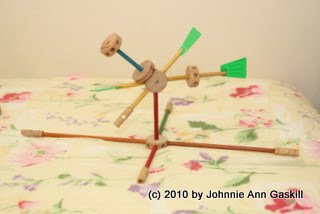
A few weeks later, I was reminded of that experience the morning my grandson (age 3) began playing with Tinkertoys the three older grandchildren have enjoyed through the years. As he dumped the wooden sticks and circles and other components onto the bed where we were playing, the instruction sheet fell out.


“Nana, let’s make these,” Michael said, pointing to the diagrams.

“Honey, we can’t,” I said. “Some of the pieces we need are lost.”

Not upset by that, he began using the available pieces to make unique designs. For a time, I worked alongside him, creating fairly typical things like a flower, etc. But I began to notice that he wasn’t even attempting to create anything that already had a name. He was simply having fun fitting all the pieces together—in no particular order. And, let me tell you, he created some rather grand designs.

Naturally, I had to take pictures of him and his creations. So, for more than an hour he continued to be engrossed in his designs as I snapped photo after photo. (The external flash on my camera was pointed toward the white ceiling, causing reflected light to fall softly upon him, keeping him from being distracted—or blinded—by bright light.) While he played with his toys, I “played” with my camera by changing settings and lenses and shooting positions, and so forth. So, once again, as during the photography workshop, “A good time was had by all.”


As I reflect on that, I wonder why we adults rarely permit ourselves to enjoy creative activities. Why do we feel we ought to suppress that wonderful ability our Creator has placed within us? After all, He is creative! Beginning with the first book in the Bible, there are all sorts of acknowledgements of His creativity. Since He obviously enjoys expressing His creativity and surveying with pleasure His work, shouldn’t we?

©2010 by Johnnie Ann Burgess Gaskill. For permission to use, please contact her at johnniegaskillDOTgmailDOT com.

Saturday, September 18, 2010

Drip! Drip! Drip!

Drip. Drip. Drip. One drop followed another, each splashing into a glass bowl half-filled with water. Our assignment was to photograph a drop after it hit the water and splashed upward. That was easier said than done!

Some of the 11 photographers who were trying to accomplish that ended up with a few beautiful images. As you might guess, not every picture was a keeper. One photographer said she tried more than 50 times to get a shot she liked. I finally managed to snap a few pictures of drops as they rebounded from the water; but, alas, none of mine were sharply focused. Therefore, I won’t be able to use them in any way. However, I plan to keep a few of the best ones on my hard drive, since they represent my first attempt at photographing a water droplet in motion.


Frequently throughout the all-day photography workshop, we had to use an empty detergent bottle to suction out the excess water in our bowls. I was surprised at how quickly the bowls filled up. After all, there was only one drop falling at a time. Drip. Drip. Drip. Yet, those individual drops made a difference!
A few days after the workshop, I listened to a speech that had been given at a photography workshop a year ago. The speaker reminded everyone that sales, even little ones, do add up. “It’s like water dripping from a faucet,” she said. “Drip. Drip. Drip. Your little successes may not seem like much, but, over time, they’ll add up.”

Her words encouraged me, not only in regard to photography, but to life in general. Little things we do consistently and to the best of our ability will, over time, make a difference.

For example, since I’ve rejoined The Wellness Center, I’m hearing about dramatic changes in many of the people who go there regularly to exercise. One friend has lost over 40 pounds. Another now has a full range of motion in knees that once were too stiff and sore to move very much. Another has lowered (significantly!) her blood pressure and cholesterol.

These changes didn’t happen overnight. Like the drip, drip, drip of the water, the frequent visits to the Wellness Center, over time, slowly added up, making a noticeable difference.

Rather than just sitting around wishing, hoping, and praying for change, the clients are working day by day to achieve their fitness goals. And, as I said, they are experiencing remarkable success.

No matter where we want to go in life or what we want to achieve, we reach our goal step by step by step, don’t we? Whether it’s restoring order to a cluttered space or training for a career, we do it bit by bit by bit.

As I reflected on all these things, I recalled a parable (an earthly story with a spiritual application) Jesus told. In the story, three servants are called to appear before their master to give an account of how they had managed the money he had given to them to use while he had been away. Two servants had managed the money wisely; one had not.

Read all about it in the 25th chapter of Matthew. Notice what the master said when he commended the two wise servants: “You have been faithful in handling this small amount, so now I will give you many more responsibilities. Let’s celebrate together!” (verses 21 and 23).

Being faithful in little things really does matter! So, let’s consistently take the small steps needed to get us to wherever we want to go. Step. Step. Step.

©2010 by Johnnie Ann Burgess Gaskill. For permission to use the photos and/or the text, please contact her.