Thursday, September 25, 2014

Wabi-Sabi

At the conclusion of a Toastmasters meeting, the leader said, “The theme for our next meeting will be wabi-sabi.”

Well…that theme was quite different from recent ones, such as enthusiasm, being prepared, rise and shine, etc., all of which were easily understood. But wabi-sabi????

Naturally, I made a bee-line for her after the meeting and smiled as I asked, “Just what is wabi-sabi?”

“It’s a Japanese word that means a way of seeing beauty in things that are imperfect, like a cracked vase. People who understand wabi-sabi intentionally place the vase so that the imperfection can be seen rather than hidden.”

After the meeting, I logged on to the internet to find out more about wabi-sabi. I learned that ancients Greeks once prized beauty; westerners desire perfection; but those who practice wabi-sabi value authenticity. They see beauty in things that are imperfect, impermanent, and/or incomplete. For example, they find beauty in things that are rough, irregular, natural, rustic…things with “character,” such as a table with a few dings and dongs, a chipped cup, wrinkled faces, etc. 

      My goodness! I thought. I’ve been practicing wabi-sabi for years and didn’t even know it! To prove it, I looked through my collection of digital photos and found many images I’d made of what I considered beautiful “finds.” I’d found them in unexpected places. For example: an outhouse made of rough wood standing beside acres of sunflowers in full bloom, outgrown children’s shoes being used as small planters, an old worn-out shoe providing a home to a plant in need of care, textured walls in an abandoned building, dried blooms silhouetted again a November sky…


 One of my all-time favorite wabi-sabi photos is one of my mother’s hands, taken when she was 86 years old. I liked it so much I even wrote a poem about her hands and placed those words onto the photo itself.


The more we accept the imperfect elements in our environment and consider them interesting and beautiful, the more willing we’ll be to let go of our relentless quest for perfection—not only in things but also in people—including ourselves!

Sunday, August 31, 2014

Undiscovered


To myself I am only a child playing on the beach, 
while vast oceans of truth lie undiscovered before me.
    ~Isaac Newton


Wednesday, August 27, 2014

Make Life Beautiful

In an article in the June 2013 issue of Southern Living magazine, writer Allison Glock talks about her great-grandfathers’ gardens, which were as different as the men themselves. One man’s garden was formal. The other’s was wild and free. Yet, each one was filled with beauty.

“In both houses,” Allison says, “there were jars of fresh flowers, blooms that reminded them that life could be beautiful, that they could make it so” (p. 78, “Portrait in Green”).

As I reflected on her words, I recalled the times I’ve visited (and photographed!) the garden of a humble, gentle-spirited man who lives in a small house. Like Allison’s great-grandfathers, this man has also surrounded himself with beauty.

He has planted flowers almost everywhere in his small yard. Other than a grassy pathway, which runs alongside his house and leads to his “sitting area” and to his small vegetable garden near the back fence, almost every available inch of his yard is ablaze with color.


In order to add a splash of color to the part of the yard that is more utilitarian than beautiful, he has hung a sunflower flag on a tree near a table covered with an assortment of unfilled flower pots.


He is happy to share the beauty of his garden with others. For example, when children in his neighborhood ask to be allowed to help him plant and weed and water, he teaches them to care for the plants and to appreciate their beauty, as he does.

Like Allison’s great-grandfathers, he believes life can be beautiful and that people can make it so.

They’re right, aren’t they? We can—and do—cultivate beauty in all kinds of spaces, whether in huge formal gardens surrounding a mansion or in limited space alongside a small house.

We also create beauty in all kinds of ways, not just in flower gardens. Consider: the chef who makes each entrĂ©e a work of art…the fashion designer who adds detail to a garment to make it uniquely beautiful…an interior designer who knows just what to put where in order to create a stunningly beautiful room.

Even folks who don’t get paid to create beauty do it instinctively. Take, for example, the person who creates beauty by artfully arranging assorted, chopped, colorful veggies…the man who washes and waxes his car until it looks brand new...the child who gathers a handful of wild flowers to present to her mother... the toddler who draws on a wall with a crayon…


Because we humans have an innate longing for beauty, we either find it—or create it!

Poets and writers use words to paint pictures for us to enjoy; photographers and artists create visual feasts. Even folks who don’t consider themselves artistic or creative, crave beauty and, thus, create it in all kinds of places and with whatever materials are at hand.

Even when life is hard—especially when life is hard—we have a need for beauty. We flank caskets with flowers to soften the harshness of death. We place flowers and balloon bouquets around the room of those who are ill. We dress in bright colors in order to lift our spirits.

Yes, life can be beautiful. And we should make it so! In the process, let’s also take time to thank our Father for the beauty He’s already provided for us, as Folliott S. Pierpoint did when, in 1864, he penned these words:
For the beauty of the earth,
For the glory of the skies,
For the love which from our birth,
Over and around us lies;
Christ our God to Thee we raise
This our hymn of grateful praise.


Tuesday, August 5, 2014

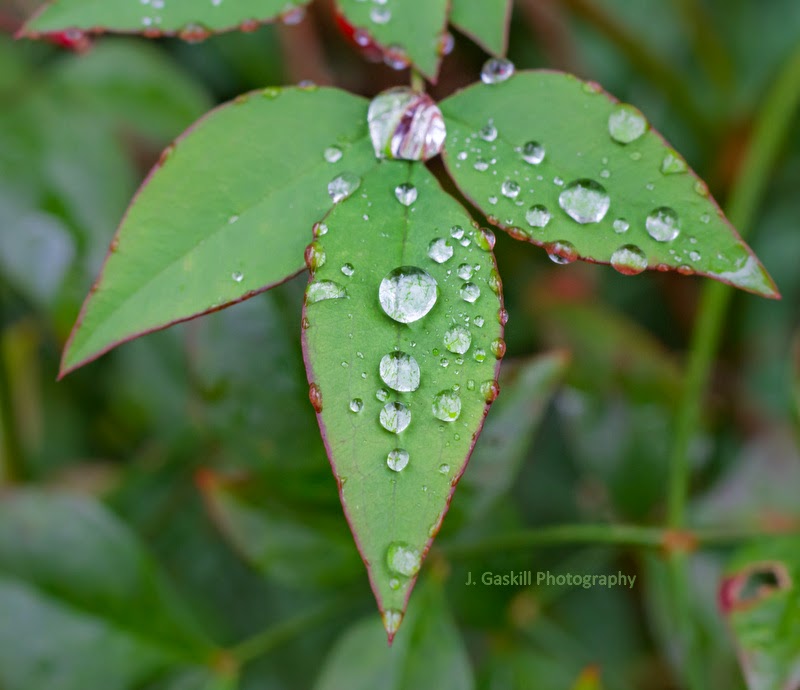
After a Rain


Have you ever seen clearer shining than that which follows a shower? Then the sun transforms the rain-drops into gems, the flowers look up with fresher smiles and faces glittering from their refreshing bath, and the birds from among the dripping branches sing with notes more rapturous, because they have paused awhile. So, when the soul has been saturated with the rain of penitence, the clear shining of forgiving love makes the flowers of gladness blossom all around.

~From a sermon ("The Joy of the LORD, the Strength of His People") delivered by C. H. Spurgeon on the Lord's Day Morning, December 31, 1871, at the Metropolitan Tabernacle, Newington


Tuesday, July 8, 2014

Describe Your Perfect Day

“Describe your perfect day,” was one of the thought-provoking assignments given during the Table Topics portion of the ToastMasters meeting. As soon as it was announced, my heart began to pound, and I fervently hoped the person who’d given the challenge wouldn’t call on me to stand up and speak on that topic for at least one minute.

Any kind of public speaking is scary enough, but to have to stand up, collect your thoughts, and speak sensibly about a topic that was presented to you just seconds before, leaving you zero time to figure out what you’re going to say—and certainly no time to rehearse—makes speaking that much more frightening.

So, whenever I’m called upon during Table Topics, I just start praying that I’ll have something fairly sensible to say and that I won’t die from fright! I don’t worry about whether I’ll receive a blue ribbon (like the one shown below) for having given what those in attendance consider the “Best Table Topics” response. Oh no! I just worry about surviving the ordeal and also about “saving face.”
Thankfully, I was not called upon to describe my perfect day, but that assignment intrigued me so much that I decided I’d write out my response—after I’d gotten home and was sitting on the guest bed, with several big, comfy throw pillows at my back, a laptop on my lap, my heart beating a normal rhythm, no eyes upon me eagerly waiting to hear what I’d say…But even with most of the stress gone, I still had trouble describing what would be a perfect day for me.

Perhaps the difficulty was due to the fact that I tend to be happy with almost every day! I like my life. Sure, it would be nice to:
·  go on trips to faraway places like New Zealand or Ireland
·  win a million dollars
·  be given a new camera and some new lenses
·  see miracles done in the lives of those who are grieving or are critically ill or bankrupt
·  know that the world was at peace and that all the soldiers were back home, unharmed and with their families.

But rather than wish for things that are probably NOT going to happen, I’ve decided to be content with the life I’ve been given. So, a perfect day for me is one that holds blessings often taken for granted—for example, to be able to:
·  live independently in my own home
·  do my own work (yes, even unloading the dishwasher!)
·  walk three or more miles
·  eat healthy foods (but not in excess)
·  come and go as I please
·  rest whenever I’m tired
·  talk to/be with family and friends
·  enjoy my hobbies: reading, taking and editing pictures, writing, walking
·  feel like my life has meaning and purpose, etc.

Bottom line: I feel so very grateful for the life I do have. Although I have dreams, as well as longings for miracles, I’m content with each day the Lord gives me. However, if I were to give a lot of thought as to what a perfect day would look like, I might become discontent with the wonderful life I currently have. Thus, I’ll give heart-felt thanks for my current blessings, and if the Lord should opt to give me some of the things I can only dream about at this point, I’d certainly thank Him for putting extra icing on the proverbial cake He’s already provided for me to enjoy.

(C) 2014 by Johnnie Ann Gaskill

Sunday, July 6, 2014

Lessons from Flowers

As folks who know me can attest, I enjoy photographing flowers of all kinds. I don’t delight in making or maintaining the garden itself, but I do love it when I have an opportunity to photograph the flowers in other folks’ gardens. Fortunately, sweet friends often invite me over to photograph the beautiful results of their hard work. And my husband and I are blessed to be able to travel a good bit, too. When we’re “on the road,” we’re always on the lookout for parks, botanical gardens, plant nurseries, businesses with flowers out front, hanging basket lining the city sidewalks, courtyard in the downtown area, small gardens near entrances to the hotels where we stay, etc.


Although gardens require a good bit of money, time, attention, and hard work, wildflowers don’t. Quite the contrary! They just appear in various places and seem to do very well without human intervention. Many of my favorite “flower photos” are of wildflowers--and also weeds with beautiful blooms. I even love dandelion blooms and seed heads.

Because of my love of beautiful blooms, these three verses in Isaiah 40 captured my attention: “All flesh is grass, and all its loveliness is like the flower of the field. The grass withers, the flower fades, when the breath of the LORD blows upon it; surely the people are grass. The grass withers, the flower fades, but the word of our God stands forever” (vv.6-8, New American Standard Bible).

These verses point out how temporal our lives are. Even though we, like the grasses of the field, bloom and flourish for a time, we will not be here forever. We, like the grasses, will wither and fade; and those who pass by where we used to live may scarcely remember us—if at all.

Yet, God, who is eternal, created us for His good pleasure and lets us live and flourish for a season, as He does the wildflowers and the grasses of the field. In fact, Jesus referred to the beauty of the grasses of the field when He was reminding His followers not to worry about what they would eat or drink or wear. “And why are you anxious about clothing? Observe how the lilies of the field grow; they do not toil nor do they spin, yet I say to you that even Solomon in all his glory did not clothe himself like one of these. But if God so arrays the grass of the field, which is alive today and tomorrow is thrown into the furnace, will He not much more do so for you, O men of little faith?” (Matthew 6:28-30, NASB).


Thus, we should not worry about our lives, but simply bloom where God has planted us and let our lives testify to HIS glory and goodness.
 (C) 2014 by Johnnie Ann Gaskill

Saturday, July 5, 2014

His Works


Last evening, our immediate family gathered at our older daughter’s home to enjoy family time and to celebrate the 4th of July by having fun with some fireworks the guys had provided. We laughed and talked and screamed and covered our ears and ran around as the sparklers spit and sputtered and zoomed and boomed. After the fireworks had been used up, we gathered our belongings and hugged each other, saying what a fun time we’d had while making some wonderful memories.

But while I was still seated in one of the folding chairs, I happened to look up at the sky. The stars were twinkling in the velvety black night sky, making no sound whatsoever. How beautiful. How serene. And certainly a huge contrast to all the noise and flashing lights we’ve just experienced, I thought. And it was.

I thought about the stars the next morning when my daily Bible reading brought me to Isaiah chapter 40, where I found these words in verse 26: Lift up your eyes on high and see who has created these stars, the One who leads forth their host by number, He calls them all by name; because of the greatness and the strength of His power, not one of them is missing (NASB).

While we’d been laughing and talking and having fun with manmade lights, the Creator had been providing an awesome show in the night sky, as He has been doing night after night for untold centuries. It’s sad that we rarely see it. It’s sadder still, that, seeing it, we fail to worship the One who created those stars—and everything else!

(C) 2014 by Johnnie Ann Gaskill

Note: I failed to take a picture of the night sky, but here is one that I took (through the windshield) while my husband was driving us to the fireworks show. The clouds also were created and are sustained by the Creator, as are the family members He's blessed us with! Seeing His work should remind us to praise and thank HIM.


Thursday, July 3, 2014

The Creator's Works

One day a week or so ago when my daily Bible reading brought me to the 104th chapter of Psalms, I came to these words: “O LORD, how many are Your works! In wisdom You have made them all; the earth is full of Your possessions. There is the sea, great and broad, in which are swarms without number, animals both small and great” (Psalm 104:24-25, New American Standard Bible).

Immediately, I recalled places my husband I had especially enjoyed this past May while on a trip to northwestern Nevada and northern California. One place in particular seemed to fit the Scripture passage. So, I mentally returned there to reminisce about what we’d seen and experienced in the Fort Bragg area of California. While standing on the bluffs overlooking the Pacific Ocean, we’d seen not only the beautiful blue waters of the seemingly endless Pacific, but also two harbor seals sunning themselves and a migrating whale that surfaced just for a moment. We’d been intrigued by men in scuba diving suits who’d managed to get down the steep, treacherous cliffs to search around the rocks for abalone and other creatures hiding there. 

As I recalled such scenes, I realized anew that the psalmist was exactly right in giving the Creator the credit for all the wonders we’d seen on that trip—as well as those we see all around us every day! What a beautiful world He has made!

(c) 2014 by Johnnie Ann Gaskill

Monday, June 30, 2014

Searcher of Hearts

Yesterday at church, the congregation sang a song I’d never heard before. As I haltingly sang along, most of the time off key, I realized that the words were “keepers” even if I couldn’t sing them well. So, today, I did a Google search for the hymn (Searcher of Hearts, From Mine Erase) and found the lyrics and the music here: http://cyberhymnal.org/htm/s/h/shfmeras.htm

 I’ve printed myself a copy of the words so that I can sing along as I listen to the music. Whether or not my singing improves, I’m going to memorize the words, much like I would a poem, and use them as a prayer.

I’ve learned several songs/prayers this way: As I walk (one to three miles daily) round and round inside my house (because it’s too hot and humid for me to do that many miles outside), I hold in my hand the copy of whatever I’m trying to memorize. As I make my laps, I repeat one phrase at a time until I get it right, without looking at the sheet in my hand, and then I learn the next one. Once I feel comfortable with the second one, I say out loud the first one and the second one over and over until I can do both correctly. Then, I follow that pattern with the rest of the phrases until I’ve learned the whole thing. 

Each day, I review my recent memorizations. Then, if I have a new one, as I will have today, I begin on it. I’m never concerned with the speed with which I learn a new message. But I do focus on learning to practice, to “live by,” the words I’ve stored in my inner being. Otherwise, the memorization is only an exercise for my brain rather than a “life changer.”


I’ve always had a hard time memorizing “word for word” poems, Bible verses, and so forth. Thus, I’m excited that my new routine is helping me to exercise my mind, as well as my body, while also enabling me to store good thoughts in my mind and heart. It’s a win-win activity! I encourage you, Dear Reader, to try my new habit and see if it works for you.

(c) 2014 by Johnnie Ann Gaskill